WATER CHALLENGE
Avoiding Dry or Low-Production Water Wells
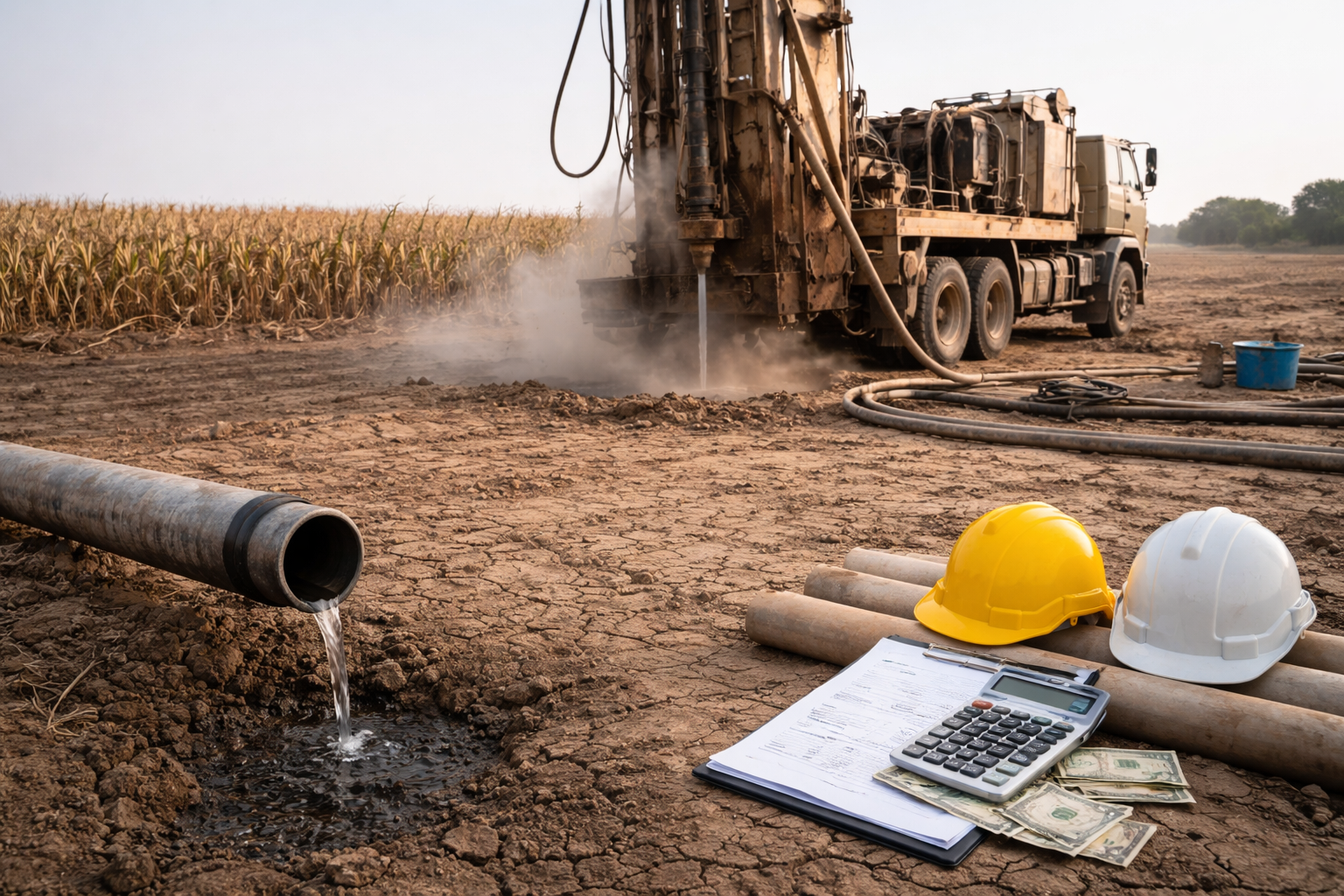
Drilling a new agricultural water well is a major capital decision. When a well comes in dry — or produces significantly less water than expected — the financial consequences extend far beyond the drilling invoice.
In many regions, operators report drilling multiple underperforming wells before identifying a sustainable source. As drilling depths increase and costs rise, the margin for error continues to shrink.
Reducing the risk of dry or low-production wells requires a clearer understanding of subsurface conditions before committing to another drilling program.
Why Dry or Low-Production Wells Occur
Dry wells are rarely random events. In many cases they are related to the same factors that cause existing wells to lose production over time. They often reflect incomplete understanding of groundwater distribution beneath a specific property.
Common contributors include:
- Targeting shallow aquifers that have declined over time
- Drilling into discontinuous or fractured formations with limited yield
- Interference from nearby agricultural or municipal pumping
- Relying on regional assumptions rather than property-specific data
- Encountering saline or poor-quality water instead of usable fresh groundwater

This leads to an important insight:
In many cases, groundwater is still present — but not where earlier wells were positioned or where traditional methods suggested it would be.
The challenge is identifying those zones before committing to another major drilling expense.
The Financial Impact of a Dry Hole
A dry or low-production well affects more than one budget line.
It may result in:
- Immediate drilling losses
- Lost planting or grazing cycles
- Reduced livestock capacity
- Increased pumping costs from deeper water
- Delayed expansion or refinancing plans
- Additional capital deployed into repeat drilling
For commercial operations managing multiple wells, repeated underperformance compounds financial risk quickly.
As drilling costs rise, even one unsuccessful well can significantly alter annual projections.
Traditional Experience — and Its Limits
Experienced drillers, local knowledge, and traditional methods remain valuable in many regions. In areas with stable groundwater conditions, they often produce reliable results.
However, groundwater systems are dynamic. As aquifers decline, pumping patterns shift, and recharge conditions change, historical experience alone may not provide the level of certainty required for high-cost drilling decisions.
The issue is rarely whether water exists — but whether its depth, thickness, and yield can be confidently estimated in advance.
Why Location Precision Matters More Than Depth Alone
Drilling deeper does not automatically reduce risk. Many dry or low-production wells occur because drilling targets depth rather than formation quality.
Groundwater success depends on:
Target the Right Water-Bearing Zones
(Productive formations beneath your property)
Evaluate Thickness, Continuity, and Recharge
(Long-term sustainability — not just initial yield)
Avoid Saline or Marginal-Quality Zones
(Protect water quality and usability)
The critical question is not simply “How deep should we drill?” — it is “Where is the most viable formation beneath this specific property?”
Before committing capital, reducing uncertainty around subsurface location can materially improve outcomes.
Reducing Risk Before Drilling Again
Before committing to another well, agricultural operators typically face three options:
Drill again and accept uncertainty
Reduce water usage and limit operations
Assess subsurface data first
This allows drilling decisions to be made with greater confidence and lower financial exposure.
When drilling costs are substantial, reducing uncertainty becomes part of sound capital planning.
Many operators begin by improving their understanding of how groundwater can be located beneath a specific property before committing to another drilling program.
How AquaterreX Supports Risk-Reduced Decisions
AquaterreX integrates geospatial analysis, subsurface data interpretation, and on-site verification to identify promising water-bearing zones before drilling begins.
Our approach helps:
Identify areas with higher probability of sustainable yield
Estimate depth and thickness of productive formations
Evaluate likelihood of fresh, non-saline groundwater
Pinpoint optimal drilling locations
AquaterreX has completed 30 consecutive agricultural projects with confirmed water discoveries across multiple regions.
While no method eliminates risk entirely, improving certainty before drilling can materially improve financial outcomes.
FAQs
Reduce Risk Before You Drill Again
Before committing to another well, understand the subsurface conditions that affect yield, depth, and long-term viability. These risks are part of a broader set of water challenges facing farms and ranches today.
See how AquaterreX helps agricultural operators reduce drilling uncertainty.