WATER CHALLENGE
Why Groundwater Location Is Often Uncertain
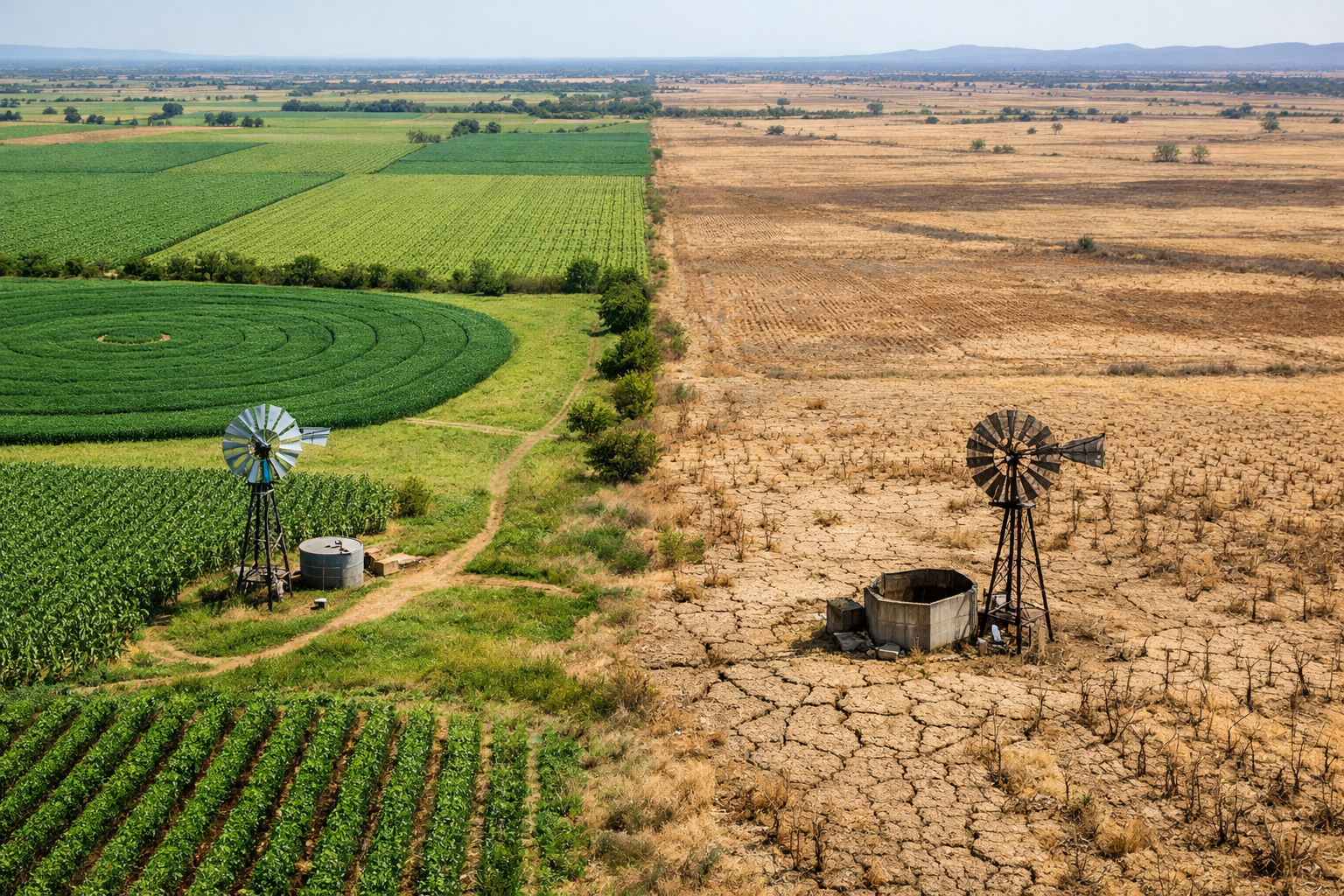
Across farming and ranching regions, many landowners know water exists underground — but determining where groundwater is located beneath a specific property is not always straightforward.
Two wells drilled only a short distance apart can produce dramatically different results. In some cases, this is why water wells that once produced reliably begin to decline over time. One may deliver reliable water for decades, while another struggles to meet operational needs.
This variability is one reason drilling new wells sometimes produces inconsistent outcomes.
For many agricultural operations, the real challenge isn’t whether water exists — it’s determining where the most viable groundwater zones are located before drilling.
Why Groundwater Availability Varies
Groundwater does not exist as underground rivers or lakes. Instead, it moves through fractures, porous rock layers, and aquifers that vary significantly across short distances.
Even within the same property, groundwater conditions may differ due to:
- Changes in subsurface geology
- Variations in aquifer thickness and permeability
- Long-term recharge patterns
- Interference from nearby pumping
Because of these variations, wells drilled into different formations — even nearby — can produce very different yields.
These patterns can also change during prolonged drought periods that affect aquifer recharge.

This leads to an important insight:
Water may still exist beneath a property — but the most productive zones may not be where earlier wells were drilled.
The challenge is identifying those zones before committing to another major drilling expense.
Why Simply Drilling Another Well Can Be Risky
When wells stop producing enough water, the most common response is to drill another well nearby or go deeper in the same location.
While this approach sometimes works, it also introduces risk.
Without better subsurface information, drilling can result in:
- Dry holes
- Low-yield wells
- Saline or poor-quality water
- Significant drilling costs without solving the underlying problem
Many landowners report drilling multiple underperforming wells before seeking additional analysis.
As drilling costs continue to rise, reducing uncertainty before drilling becomes increasingly important.
This is one reason many operators focus on avoiding dry or low-production water wells before committing to new drilling.
Traditional Methods and the Role of Certainty
Agricultural operators have long relied on traditional approaches — including local knowledge, experienced drillers, and in some regions even water witching — to guide drilling decisions.
In areas with shallow or widespread groundwater, these methods can sometimes lead to successful wells.
However, traditional approaches often cannot provide detailed insight into:
- Where the most productive formations exist
- How deep viable groundwater may be
- Whether water quality will meet operational needs
Traditional methods may suggest general areas where water might be found, but they rarely provide the level of detail needed to confidently select drilling locations.
As the cost of drilling increases, the focus often shifts from simply finding water to reducing uncertainty before investing in a new well.
Why Location Matters When You Locate Groundwater
Many well projects focus primarily on how deep to drill. However, drilling deeper does not automatically improve the chances of success.
Groundwater productivity depends far more on intersecting the right water-bearing formations than on depth alone.
Successful wells typically intersect formations that offer:
Productive water-bearing zones
Adequate formation thickness and recharge
Fresh, usable groundwater
The key question often becomes less about depth and more about where the most viable formation exists beneath a property.
Practical Next Steps When Groundwater Is Uncertain
When groundwater production becomes unpredictable, landowners typically consider three paths:
Reduce usage and limit operations
Adjust irrigation, livestock capacity, or cropping plans to match available water.
Drill additional wells and accept the risk
Attempt to improve production through additional drilling.
Assess subsurface conditions before drilling again
This third approach focuses on improving understanding of groundwater conditions before committing additional capital.
How AquaterreX Supports Informed Water Decisions
AquaterreX helps agricultural landowners locate groundwater more accurately by analyzing subsurface conditions beneath their property before drilling begins.
Our work combines geospatial analysis, subsurface data, and on-site verification to:
Identify promising water-bearing zones
Estimate likely depth, thickness, and potential yield
Evaluate the likelihood of fresh, non-saline groundwater
Pinpoint more favorable drilling locations
AquaterreX has recently completed 30 consecutive projects with confirmed water discoveries across multiple regions.
This data-driven approach complements traditional knowledge by helping reduce uncertainty before major drilling investments are made.
FAQs
Reduce Uncertainty Before Your Next Water Investment
If your existing water wells are no longer producing like they used to, the most important step is understanding why — and what options truly exist beneath your land.
Learn how AquaterreX helps landowners assess groundwater potential before drilling.