WATER CHALLENGE
Why New Water Wells Sometimes Fail
Drilling a new water well is often seen as the solution when existing wells begin to decline.
But many landowners are surprised to discover that a newly drilled well may produce little water — or none at all.
Across agricultural regions, drillers frequently encounter dry holes or low-production wells even in areas where groundwater is known to exist.
Understanding why this happens is essential before committing to another drilling investment.
Why a New Well Can Still Produce Little Water
Groundwater availability depends heavily on subsurface geology.
Water moves through fractures, porous rock layers, and aquifers that can vary dramatically across short distances.
Even within the same property, one drilling location may intersect a productive formation while another misses it entirely.
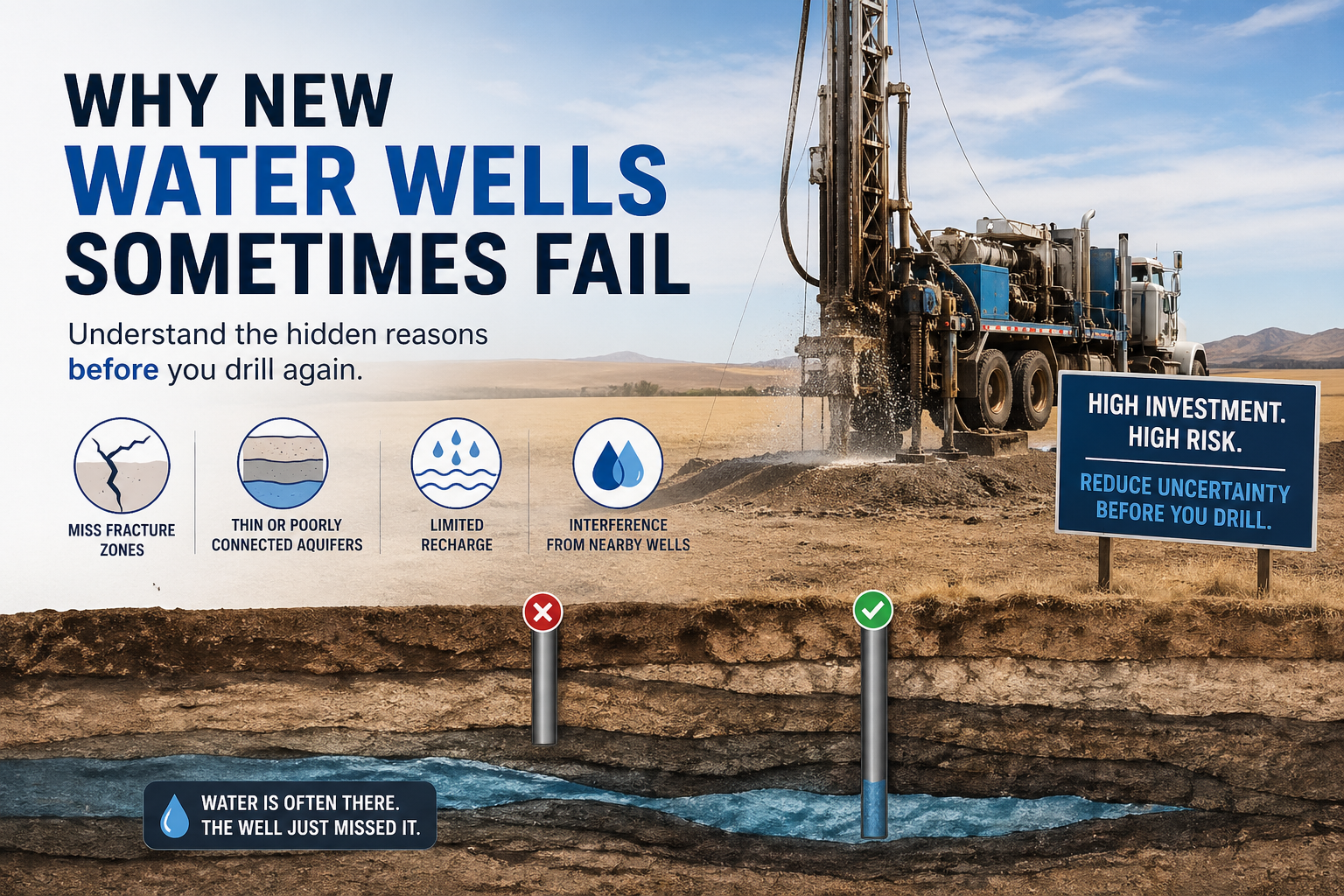
Common reasons a new well underperforms include:
- Drilling into a thin or poorly connected aquifer
- Missing fracture zones that carry groundwater
- Targeting formations with limited recharge
- Interference from nearby wells
In some cases, these issues occur in the same regions where existing wells have gradually lost production over time.

In many cases, water is present underground — but the well did not intersect the most productive zone.
The Financial Risk of Dry Holes
Drilling a new well is a significant investment.
Depending on depth and location, agricultural wells can cost tens or even hundreds of thousands of dollars.
When a well produces little water, operators often face difficult choices:
- Drill another well and accept more risk
- Reduce irrigation or livestock capacity
- Invest in deeper drilling without certainty of success
Each additional attempt increases costs while the underlying groundwater uncertainty remains.
Why Nearby Wells Can Perform Differently
It is common for wells drilled only a short distance apart to produce very different yields.
This occurs because groundwater moves through specific subsurface pathways, such as fractures or permeable formations.
If a well intersects one of these zones, production can be strong.
If it misses the formation, production may be minimal.
These differences are closely related to how groundwater is located beneath a specific property.
This is why drilling depth alone rarely determines success.
Location precision often matters far more.
Productive Wells Depend on the Right Formation
Successful wells typically intersect formations that offer:
High permeability
Adequate thickness and recharge
Fresh, usable groundwater
Even small differences in geology can determine whether a well produces hundreds of gallons per minute — or only a fraction of that amount.
Understanding these formations before drilling can significantly improve outcomes.
What Landowners Often Do After a Failed Well
When a well fails, most operators consider three options:
Drill another well nearby
Hoping the next location performs better.
Drill deeper in the same location
Attempting to intersect a different formation.
Evaluate subsurface conditions before drilling again
The third approach focuses on reducing uncertainty before investing in another well.
How AquaterreX Helps Reduce Dry Hole Risk
AquaterreX helps landowners identify promising groundwater zones before drilling begins.
Our process combines geospatial analysis, subsurface data interpretation, and on-site field verification to:
Identify promising water-bearing formations
Estimate depth and potential yield
Evaluate water quality conditions
Recommend optimal drilling locations
AquaterreX has recently completed 30 consecutive projects with confirmed water discoveries across multiple regions.
FAQs
Reduce Uncertainty Before Your Next Water Investment
If your existing water wells are no longer producing like they used to, the most important step is understanding why — and what options truly exist beneath your land. These conditions are part of a broader set of water challenges affecting farms and ranches.
Learn how AquaterreX helps landowners assess groundwater potential before drilling.