
Water Cost vs. Water Value in Agriculture: Why the Distinction Matters
By James D’Arezzo, President, AquaterreX
Every farmer and rancher already understands this at a gut level: not all water is created equal.
Two fields may use the same amount of irrigation water, yet one consistently works economically year after year while the other barely breaks even. The difference isn’t just what it costs to pump or deliver water—it’s what that water produces once it’s applied.
That distinction—water cost versus water value—has always mattered in agriculture. What’s changing is how sharply it can shape farm profitability, cropping decisions, water markets, and drought policy.
Put simply:
- Water cost is what it takes to access, pump, and deliver water.
- Water value is the economic return generated by using that water to grow crops.
The same gallon of water can generate pennies—or dollars—depending entirely on how it’s used. As water becomes more constrained and more regulated, that difference increasingly determines which operations remain resilient and which ones face hard choices.
This article looks at how water value plays out across five common crop categories—corn, wheat, alfalfa, vegetables, and orchard crops—and why understanding this distinction is becoming unavoidable for producers operating in water-limited regions.
Water Cost: What Farmers Actually Pay
As many producers have seen, water costs vary widely by region and source, but they usually include:
- Pumping energy (electricity or diesel)
- Infrastructure (wells, canals, pivot irrigation, drip systems)
- Water rights or delivery fees
- Maintenance and labor
Typical irrigation water costs often range from $0.0005 to $0.01 per gallon, depending on source and location.
(Figures shown throughout represent typical ranges reported across university extension services and agricultural agencies cited at the end.)
In practice, surface water may be cheaper; in others, deep groundwater or purchased water rights can be more expensive—especially during droughts. However, deeper groundwater can also be more reliable in the long run.
But cost alone does not determine whether water use is profitable.
Water Value: What That Water Produces
On the ground, water value is measured by how much crop revenue is generated per unit of water. This varies dramatically by crop type.
Below, we compare how the same water performs economically across different crops.
Corn: Low Value per Gallon, High Volume Use
As many producers have experienced, corn is one of the most water-intensive crops when measured per dollar of output.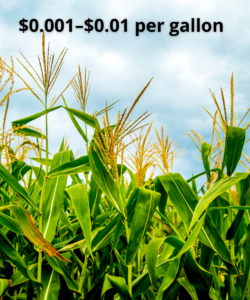
- Requires large volumes of water
- Grown on vast acreage
- Low market value per unit
Typical water value:
Approximately $0.001–$0.01 per gallon
Corn remains economically viable because of scale, mechanization, and stable demand—not because each gallon of water is highly productive. In water-scarce regions, corn is often the first crop reduced or fallowed during shortages.
Wheat: Similar Economics to Corn
Wheat shows a water-value profile similar to corn: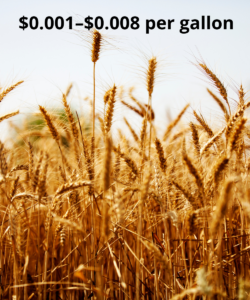
- Moderate to high water use
- Relatively low crop prices
- Often grown in semi-arid regions
Typical water value:
Roughly $0.001–$0.008 per gallon
While wheat is essential for food security, it offers limited economic return per gallon of irrigation water, especially where rainfall isn’t reliable.
Alfalfa: Higher Value, Export-Drive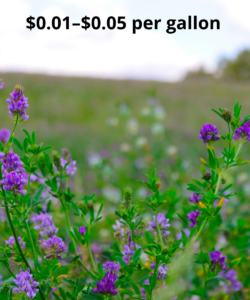
Alfalfa represents a step up in water value:
- Perennial crop with multiple harvests
- High protein value for dairy and livestock
- Strong export demand in some regions
Typical water value:
Approximately $0.01–$0.05 per gallon
Although alfalfa uses large volumes of water, it produces more value per gallon than corn or wheat. This makes it attractive in regions with established water rights, but controversial in drought-prone areas.
Vegetables: High Value per Gallon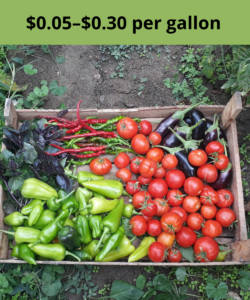
Vegetables dramatically change the equation.
- Short growing cycles
- High market prices
- Efficient irrigation systems (often drip)
Typical water value:
Approximately $0.05–$0.30 per gallon
An acre-foot of water used for vegetables can generate 10–40 times more revenue than the same water used for grains. This is why water shortages often shift acreage toward vegetables rather than field crops.
Orchard Crops: Long-Term, High-Value Water Use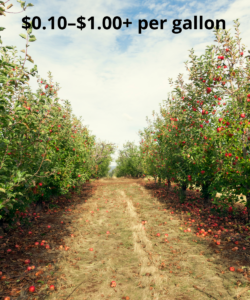
Orchard crops—such as almonds, pistachios, citrus, and apples—represent some of the highest agricultural water values.
- Permanent plantings
- High capital investment
- Strong domestic and export markets
Typical water value:
Approximately $0.10–$1.00+ per gallon, depending on crop and prices
While orchards require consistent water year after year, the economic return per gallon is far higher than most field crops. This explains why orchard water use is often prioritized during shortages.
Why the Distinction Matters
Understanding water cost without water value leads to poor decisions.
- Cheap water can still be wasted if it produces little value
- Expensive water can be profitable if used on high-value crops
- Water policy increasingly favors value per gallon, not gallons alone
This mirrors what many producers see during droughts: water tends to move away from corn and wheat and toward vegetables and orchards.
Water Value by Crop: Visual Comparison
Figure 1 illustrates the approximate economic value per gallon of irrigation water by crop, using midpoint values from reported ranges.
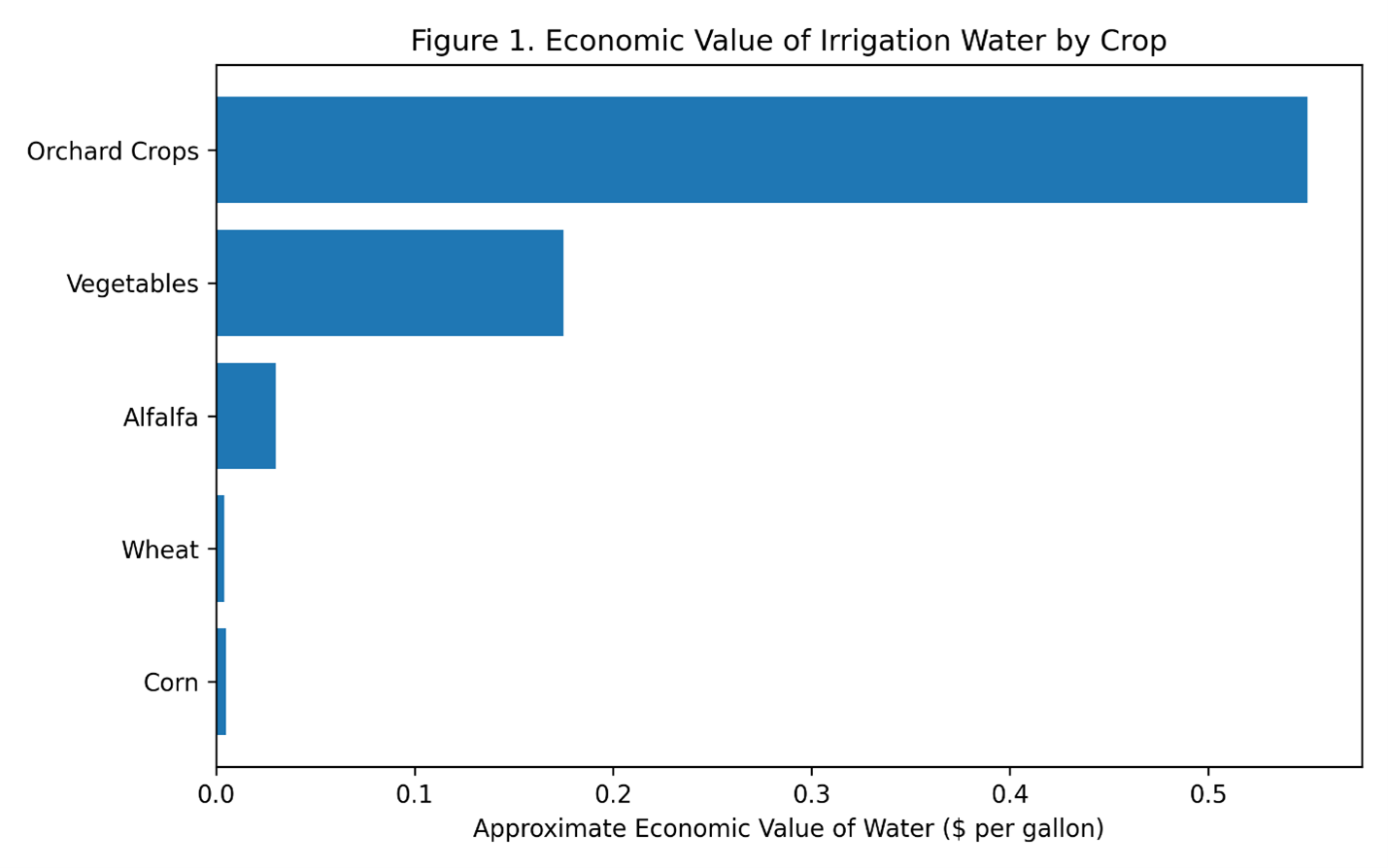
Figure 2 shows the revenue generated per acre-foot of water, highlighting differences in water productivity across crop types.
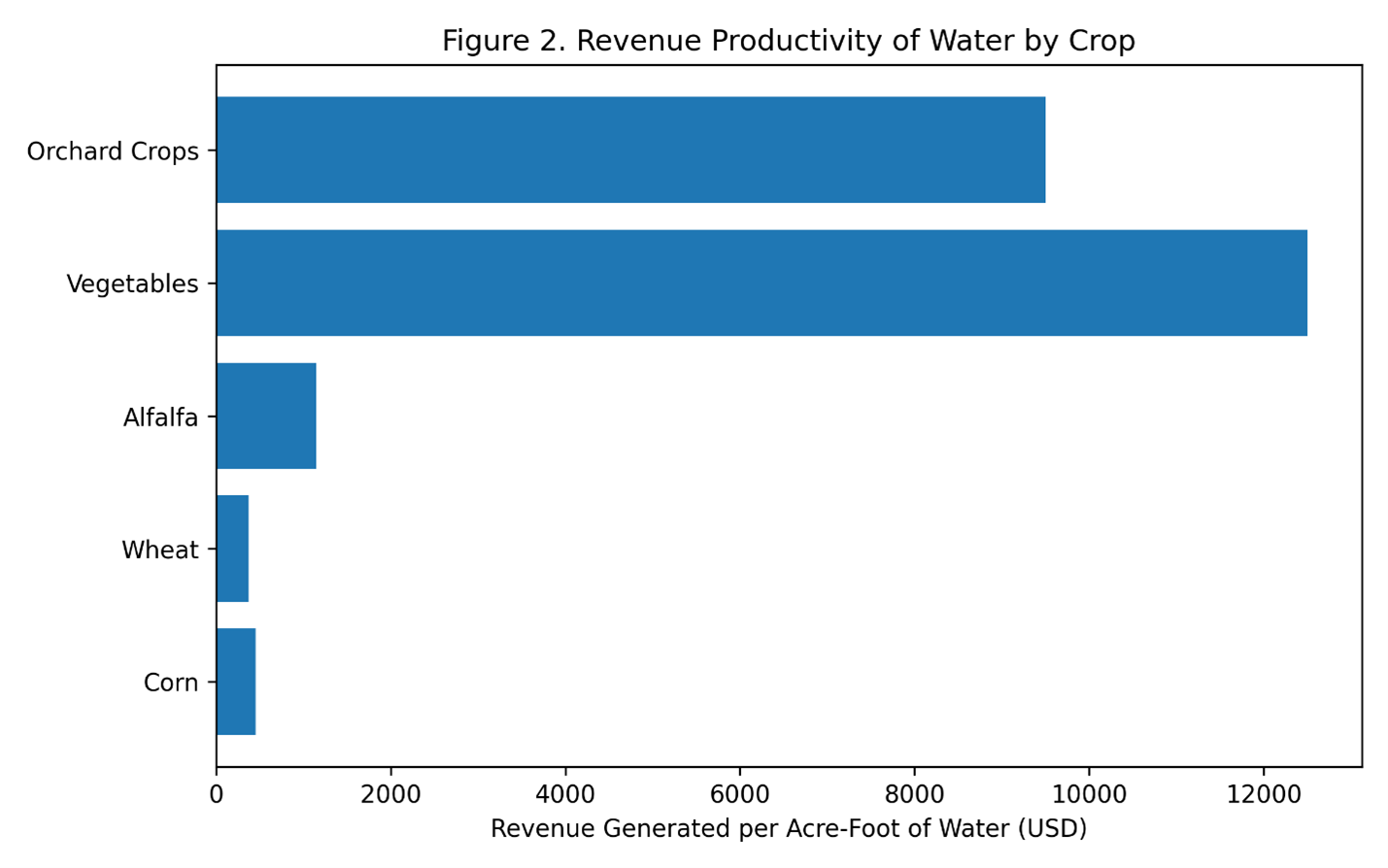 (1 acre-foot ≈ 326,000 gallons)
Figure 2 details: Revenue Generated per Acre-Foot of Water
Crop Type Approx. Revenue per Acre-Foot of Water
Corn $300 – $600
Wheat $250 – $500
Alfalfa $800 – $1,500
Vegetables $5,000 – $20,000
Orchard Crops $4,000 – $15,000+
Interpreting the Charts
These charts illustrate why water allocation decisions are increasingly driven by economic productivity rather than sheer volume:
- Corn and wheat consume large volumes of water but return relatively little value per gallon
- Vegetables and orchard crops transform water into revenue far more efficiently
- Even when water is expensive, high-value crops can justify its use
This gap explains why water markets, drought policies, and farm transitions often favor crops with higher value per gallon.
What This Means for Producers
For most farmers and ranchers, this isn’t about switching crops overnight or chasing the highest dollar per gallon. It’s about understanding where water risk and water opportunity sit on the operation.
A few practical takeaways:
- Water cost alone doesn’t tell the whole story
- Crop flexibility improves resilience as water tightens
- Long-term water reliability is becoming as important as price
- Water access increasingly affects land value and long-term planning
None of this replaces agronomy, local knowledge, or experience. But as water becomes more constrained, understanding how each gallon works for—or against—your bottom line is becoming a core management issue.
Final Takeaway
Water is not just an input—it is a multiplier.
- In low-value crops, water sustains food supply
- In high-value crops, water drives economic productivity
The future of agriculture—especially in water-limited regions—will increasingly depend on how efficiently each gallon is turned into value, not simply how cheaply it can be obtained.
About AquaterreX:
AquaterreX is a pioneer in geoscience innovation, specializing in water exploration and sustainable resource management. With Deep Seated Water technology, AquaterreX has delivered breakthrough solutions to address global water scarcity, completing over 1,500 wells and ensuring communities and industries have access to reliable, long-term water supplies. The company’s mission is to transform water scarcity into water security, empowering communities to thrive in the face of increasing demand. The name AquaterreX comes from the Latin, aqua (water) and French, terre (earth, land) which is a derivative of the Latin, terra, and “X” for exploration. Thus, AquaterreX encompasses water and land solutions for the planet.
For more information, please visit www.aquaterrex.com
📚 References
U.S. Department of Agriculture — Economic Research Service (ERS)
- The Agricultural and Economic Value of Water – comprehensive report on how economic value of water is measured in agriculture (USDA ERS, 2025). Available as a downloadable PDF.
📄 https://www.ers.usda.gov/publications/pub-details/?pubid=111489 (Economic Research Service) - Irrigation & Water Use – USDA ERS topic page discussing irrigation’s role in U.S. crop production and how irrigation helps productivity and profitability in agriculture.
🌐 https://www.ers.usda.gov/topics/farm-practices-management/irrigation-water-use (Economic Research Service) - Most Irrigation Organizations Use Uniform Prices for Water Deliveries – article explaining how water pricing and delivery systems work in U.S. irrigated agriculture.
🌐 https://www.ers.usda.gov/amber-waves/2025/july/most-irrigation-organizations-use-uniform-prices-for-water-deliveries (Economic Research Service)
Food and Agriculture Organization — AQUASTAT (FAO)
- AQUASTAT – FAO’s Global Information System on Water and Agriculture – the primary international water database covering water resources, irrigated land, and agriculture water statistics used for global water productivity research.
🌐 https://www.fao.org/aquastat/en/ (FAOHome)
California Department of Water Resources (DWR)
- Agricultural Water Use Efficiency – official DWR page describing agricultural water use, irrigation acreage, and efficiency practices in California agriculture.
🌐 https://water.ca.gov/Programs/Water-Use-And-Efficiency/Agricultural-Water-Use-Efficiency (Water CA) - Agriculture and Irrigation in California – overview of the role of irrigation in California agriculture and water use statistics.
🌐 https://water.ca.gov/Water-Basics/Agriculture (Water CA)
Public Policy Institute of California (PPIC)
- Water Use in California’s Agriculture – policy analysis describing how crop types, water use, and revenue share vary across crop categories (relation of high-value crops to water use, revenue generation).
🌐 https://www.ppic.org/publication/water-use-in-californias-agriculture/ (Public Policy Institute of California)
Additional Educational / Data Resources
- FAO AQUASTAT Water Productivity Metadata – defines water productivity concepts used in international agricultural water assessments.
🌐 https://databank.worldbank.org/metadataglossary/world-development-indicators/series/ER.GDP.FWTL.M3.KD (DataBank)