
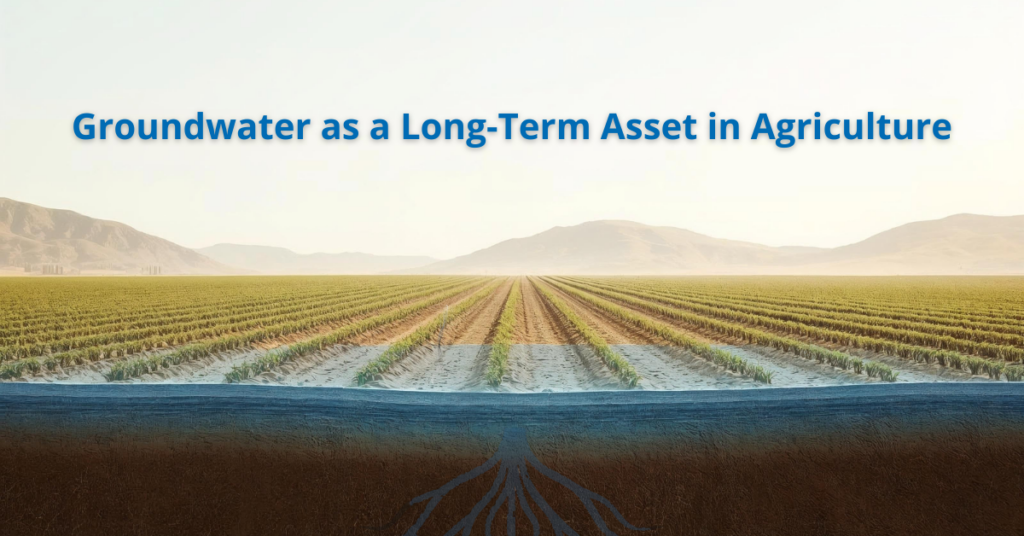
Groundwater as a Long-Term Asset in Agriculture
By James D’Arezzo, President, AquaterreX
Groundwater plays a critical role in agricultural productivity, land value, and long-term resilience, particularly in water-constrained regions. This article examines groundwater as a form of natural capital and explores how asset-based management strategies can improve farm economics, drought resilience, and long-term sustainability.
Framing groundwater as a long-term asset in agriculture, rather than a short-term consumable, fundamentally changes how producers, policymakers, and investors make decisions.
Groundwater is often treated as a hidden input in agriculture—out of sight, out of mind. Yet for many farming systems, especially in arid and semi-arid regions, groundwater is not merely a backup supply but a foundational asset that underwrites productivity, resilience, and land value over decades.
This article explores why groundwater should be managed like capital, how its value is created and destroyed over time, and what asset-based groundwater stewardship looks like in practice.
1. Groundwater Is Natural Capital, Not Just a Cost Input in Agriculture
In farm accounting, water pumping costs appear as annual operating expenses—energy, maintenance, labor. What is missing from the balance sheet is the stock of groundwater itself. Like soil organic matter or orchard trees, groundwater is a form of natural capital that provides a stream of future benefits.
Key characteristics of groundwater as an asset: – Durability: Aquifers can store water over decades to millennia. – Intertemporal value: Pumping today reduces availability tomorrow. – Risk buffering: Groundwater stabilizes yields during droughts and surface water shortages. – Nonlinear loss: Declines in water levels can abruptly increase pumping costs or cause well failure.
Treating groundwater purely as a variable cost encourages over-extraction, while treating it as capital encourages conservation and reinvestment.
2. The Asset Value of Groundwater to the Farm
Groundwater contributes to farm value in several interconnected ways:
a. Yield Stability and Risk Reduction
Reliable groundwater access reduces yield volatility. In financial terms, this lowers revenue risk and increases the certainty of cash flows—an effect comparable to crop insurance but embedded directly in the production system.
b. Crop Choice and Flexibility
Higher-value perennial crops (orchards, vineyards) often depend on groundwater reliability. The presence of a sustainable aquifer effectively expands the feasible crop portfolio of a farm.
c. Land and Collateral Value
Land with secure groundwater access typically commands higher market value. In credit markets, well capacity and aquifer condition influence lending terms, refinancing options, and long-term solvency.
3. Groundwater Depletion as Asset Liquidation
When groundwater is mined faster than it is recharged, farmers are effectively liquidating a capital asset to fund current income. This strategy can appear rational in the short run but carries long-term consequences:
- Rising energy costs as water levels decline
- Loss of shallow or marginal wells
- Permanent aquifer compaction and storage loss
- Reduced drought resilience
Unlike financial assets, depleted groundwater often cannot be restored within a human planning horizon. This makes unsustainable pumping closer to irreversible capital loss than normal depreciation.
4. Groundwater, Time Horizons, and Intergenerational Equity
Agricultural groundwater management is inherently a multi-generational issue. Decisions made today shape water availability for future operators, landowners, and rural communities.
From an asset perspective, sustainable groundwater use aligns with: – Intergenerational equity: Preserving productive capacity for future farmers – Long-term profitability: Lower lifetime costs and reduced system shocks – Community resilience: Avoiding regional well failures and land fallowing
Short planning horizons—annual leases, volatile commodity prices, or debt pressure—often push behavior toward overuse. Asset-based governance helps counteract these incentives.
5. Investing in the Groundwater Asset
If groundwater is an asset, then recharge, efficiency, and monitoring are capital investments, not regulatory burdens.
Examples include: – Managed aquifer recharge (on-farm or regional) – Soil management practices that increase infiltration – Well metering and monitoring to protect long-term capacity – Crop and irrigation system transitions that reduce consumptive use
These investments may not maximize short-term profits, but they increase the net present value of the farm system over time.
6. Deep Seated Water: An Additional Strategic Asset
Beyond shallow and intermediate aquifers, many agricultural regions overlie deep seated groundwater systems—water stored at significant depths. Deep seated water represents a distinct class of asset that warrants careful consideration.
From an asset perspective, deep seated water provides long-duration water security rather than short-cycle supply, reinforcing its role as strategic groundwater capital rather than a temporary resource.
Characteristics of Deep Seated Water
One of the most effective ways to mitigate drought risk is to tap into deeper, more sustainable groundwater sources. AquaterreX specializes in locating these untapped reserves through advanced geospatial analysis, proprietary data processing, and on-site verification methods. Unlike shallow wells, deep-seated groundwater is far less affected by seasonal droughts, offering a long-term water security solution. AquaterreX is able to locate the fractures and fissures that lead to deeper groundwater without having to drill ultra-deep wells or use specialized drilling equipment.
Until recently most experts believed that groundwater is recharged (replenished) based on the local surface drainage area. In fact, deep groundwater reservoirs, recharge systems, and subsurface flow paths operate on scales much larger than the surface drainage basin—potentially spanning hundreds to thousands of kilometers.
In a recent study published in January 2025, researchers from Princeton University and the University of Arizona created a simulation that maps underground water on a continental scale. The study also found that deep groundwater from aquifers up to 100 meters (328 feet) deep contributed more than half of the baseflow in 56% of the regional water basins.
Why Is This Important?
The fact is, in many instances there is far more groundwater available than is commonly believed. AquaterreX specializes in locating groundwater, including both shallow and Deep Seated Water, that has been overlooked. Studies like this one can serve as a wake-up call to those who require this important resource.
Groundwater Stewardship as a Long-Term Agricultural Strategy
Groundwater is one of agriculture’s most valuable—and most underappreciated—assets. When managed as capital, it supports stable yields, resilient communities, and enduring land value. When treated as a free input, it is quietly liquidated, leaving higher costs and fewer options behind.
Reframing groundwater as a long-term asset is not just an environmental argument; it is a financial and strategic one. The farms and regions that internalize this perspective will be better positioned to thrive in an increasingly water-constrained future.
Related Reading
Deep Seated Water: A Long-Term Groundwater Strategy
https://aquaterrex.com/deep-seated-water/
Artificial Groundwater Recharge Explained (USGS)
https://www.usgs.gov/mission-areas/water-resources/science/artificial-groundwater-recharge
Aquifer Compaction and Land Subsidence (USGS)
https://www.usgs.gov/media/images/aquifer-compaction-and-land-subsidence
Natural Capital in Agriculture (World Bank)
https://www.worldbank.org/en/topic/natural-capital
Continental-Scale Groundwater Flow Modeling (Princeton / University of Arizona, 2025)
https://engineering.princeton.edu/news/2025/01/07/new-research-reveals-groundwater-pathways-across-continent
https://experts.arizona.edu/en/publications/unravelling-groundwaterstream-connections-over-the-continental-un/
Managing Yield Risk in Agriculture (USDA ERS)
https://www.ers.usda.gov/topics/farm-practices-management/risk-management