
“I’ve Drilled 12 Dry Holes, and I’m Done With It.”
The real cost of drilling without enough certainty
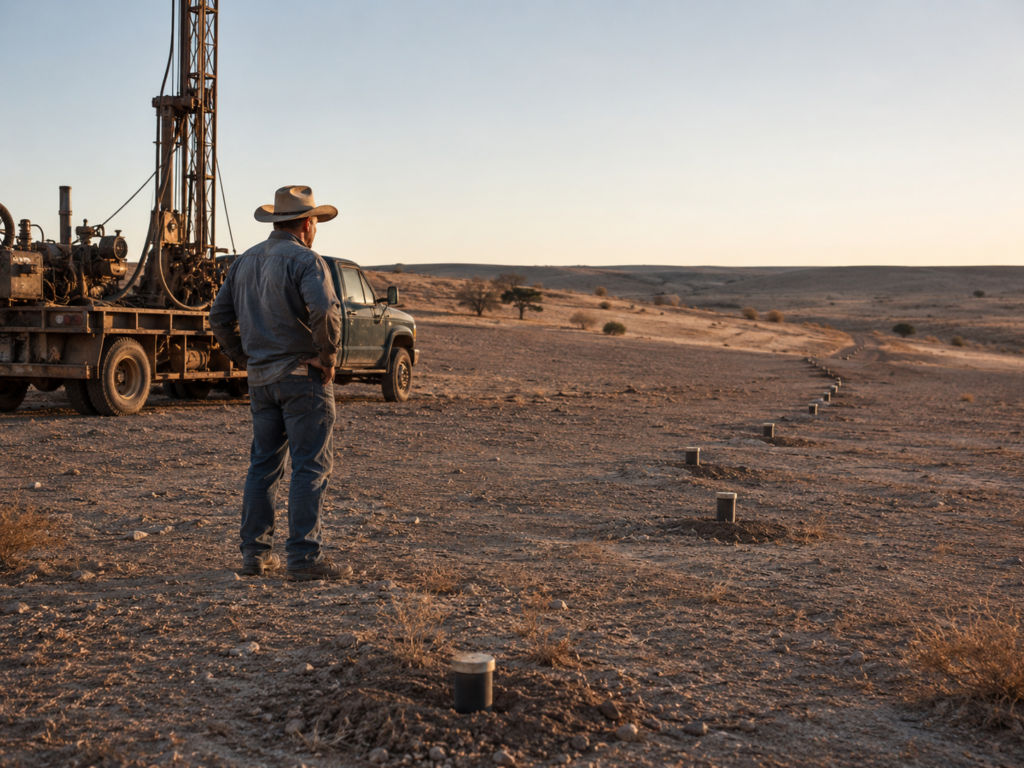
A Texas landowner recently said something to one of our AquaterreX representatives that stopped us in our tracks:
“I’ve drilled 12 dry holes, and I’m done with it.”
He had already invested in one drilling attempt after another, only to come up dry each time. But the financial cost was only part of the problem. After twelve failed holes, the bigger issue was confidence. Where do you drill next when every previous location has been wrong?
For many farmers, ranchers, and rural landowners, this is not an abstract problem. It is personal. It affects their land, their livestock, their operations, their expansion plans, and their confidence in making the next decision.
Because after one dry hole, you may still feel hopeful.
After two or three, you start questioning the location.
After twelve, you start questioning the entire process.
Dry holes are more than a drilling expense
The obvious cost is the money paid to drill.
But that is only part of the story.
Every dry hole also represents lost time, delayed plans, uncertainty, and the emotional toll of repeatedly investing in a result that never materializes. For landowners who are trying to support livestock, expand irrigation, build facilities, or make long-term decisions about their property, the absence of reliable water can put everything on hold.
And when the process becomes trial and error, the risk compounds.
One dry hole is discouraging. Several dry holes are costly. But after twelve failed attempts, the bigger issue is confidence. How do you decide where to drill next when every previous location has come up dry?
Do you drill deeper?
Move over a few hundred feet?
Try another traditional method?
Ask a neighbor?
Bring in another driller?
At some point, many landowners reach the same conclusion this Texas rancher did:
“I’m done with it.”
Why traditional groundwater searches can fall short
Finding groundwater is difficult because water does not exist in a neat, predictable pattern beneath the surface.
Two properties in the same region can have very different groundwater conditions. Even two locations on the same property can produce dramatically different results. One well may produce enough water to support an operation, while another nearby attempt may come up dry or produce far less than expected.
That is why relying on guesswork, surface indicators, or limited local assumptions can be risky — especially in areas where water is scarce, wells have failed, or drilling costs are adding up.
For many landowners, the problem is not that they are unwilling to drill.
The problem is that they need a better reason to believe the next hole will be different.
A better way to decide where to drill
AquaterreX was created to reduce the uncertainty that so often surrounds groundwater exploration.
Instead of relying on trial and error, we use advanced groundwater targeting methods to evaluate the property before drilling decisions are made. Our process combines satellite data, proprietary software, geophysical field work, and deep groundwater expertise to identify locations with stronger potential.
The goal is simple:
Help landowners drill with greater confidence — before they spend more money on another hole.
For a landowner who has already drilled multiple dry holes, this can change the decision-making process entirely. Instead of asking, “Where should we try next?” the better question becomes:
“What does the data tell us about where water is most likely to be found?”
When “one more try” is too expensive
The Texas landowner’s comment is powerful because it reflects the point many people reach after repeated failure.
They are not looking for another guess.
They are looking for a more certain path forward.
And in regions where groundwater is critical to the future of a farm, ranch, or rural property, the cost of uncertainty can be much higher than the cost of drilling.
It can mean postponed expansion.
Reduced livestock capacity.
Crop limitations.
Declining property value.
Or simply the exhaustion of trying again and again without answers.
Before drilling another dry hole, start with better information
If you have already drilled dry holes — or if you are trying to avoid that outcome in the first place — the next step should not be another guess.
It should be a better assessment of what may be happening beneath your land.
AquaterreX helps farmers, ranchers, municipalities, and landowners locate groundwater with greater certainty, including deeper groundwater sources that traditional methods may miss.
Before you invest in another drilling attempt, find out whether your property may qualify for an AquaterreX Water Discovery Assessment.
Because sometimes the most expensive hole is not the one you already drilled.
It is the next one you drill without better information.