
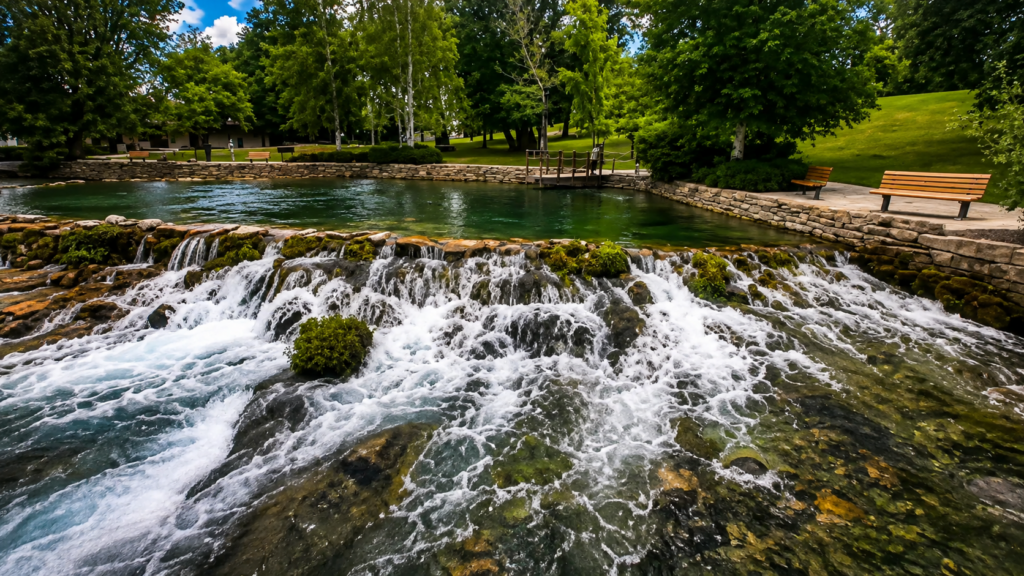
Giant Springs: Montana’s Hidden Ocean Beneath Our Feet
What One of America’s Largest Springs Reveals About Earth’s Vast Groundwater Resources
Every day, 156 million gallons of crystal-clear Giant Springs groundwater emerge naturally in Great Falls, Montana.
Not from a river.
Not from a reservoir.
Not from a dam.
It rises from deep beneath the Earth’s surface—twenty-four hours a day, seven days a week, every season of every year.
For thousands of visitors, Giant Springs is simply a beautiful destination. For hydrogeologists, however, it represents something far more profound.
It is living proof that nature has been storing, transporting, and delivering enormous quantities of freshwater underground for thousands of years.
At AquaterreX, we believe Giant Springs tells an important story, one that could help reshape how the world thinks about groundwater.
The Water Began Its Journey Long Before Human Civilization
Scientists believe the water emerging today at Giant Springs fell as rain and snow in Montana’s Little Belt Mountains approximately 3,000 years ago.
Over centuries, gravity slowly carried that water through fractures and solution channels within the Madison Limestone aquifer until it found a natural pathway back to the surface.
Today, that journey continues uninterrupted.
Every minute.
Every hour.
Every day.
The spring maintains a nearly constant temperature of 54°F (12°C) while producing enough water each day to supply hundreds of thousands of people. Giant Springs has flowed continuously for centuries and was documented by the Lewis and Clark Expedition in 1805. ([National Park Service][2])
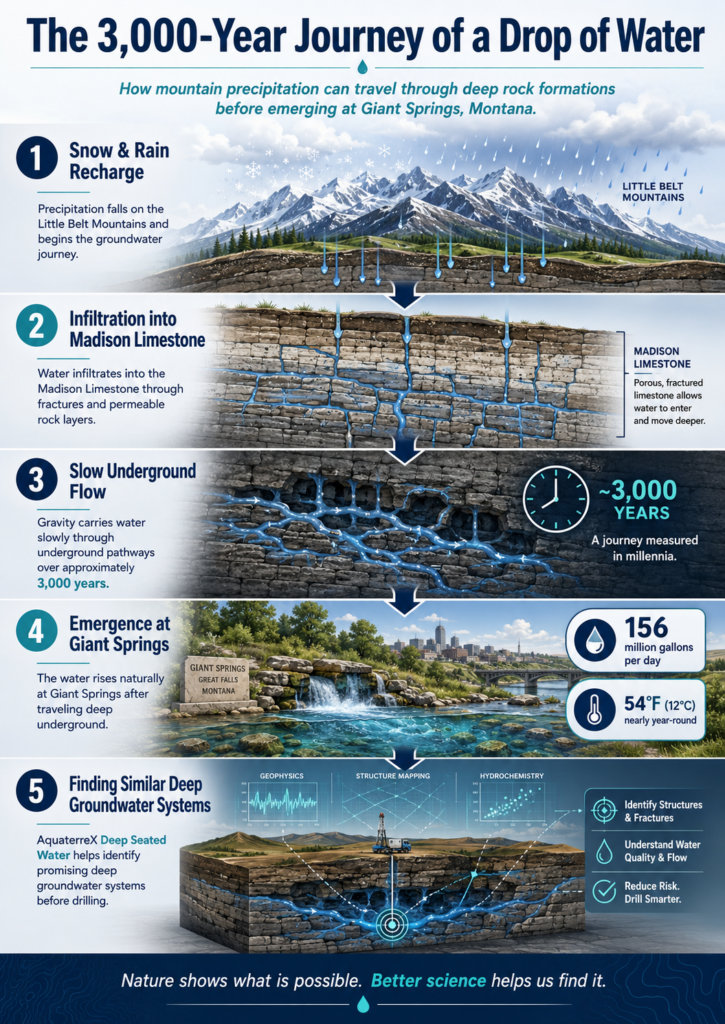
How precipitation from Montana’s Little Belt Mountains travels through the Madison Limestone before emerging at Giant Springs.
What Giant Springs Groundwater Reveals About Deep Aquifers
Around the world, thousands of major springs discharge groundwater that has traveled long distances through complex geological formations.
These springs remind us of an important scientific fact:
The Earth’s groundwater system is vastly larger than what we see at the surface.
Modern hydrogeology recognizes that groundwater moves through interconnected networks of fractures, faults, and permeable rock layers. Some groundwater follows relatively shallow, local flow paths, while other water travels through deeper, regional systems before discharging naturally at springs, rivers, wetlands, and coastlines. ([USGS][1])
In many regions, these groundwater systems have sustained ecosystems for thousands of years.
Yet much of their extent remains only partially understood.
Looking Deeper for Tomorrow’s Water
For generations, groundwater exploration focused primarily on relatively shallow aquifers.
That approach has served communities well but today’s water challenges are different.
- Growing populations.
- Expanding agriculture.
- Industrial development.
- AI data centers.
- Longer droughts.
- Increasing competition for dependable water supplies.
Meeting these challenges requires improving our understanding of the deeper geological systems that store and transmit groundwater.
That is precisely where AquaterreX is focused.
The AquaterreX Difference
AquaterreX developed its Deep Seated Water exploration technology to help identify groundwater resources before drilling begins.
Our approach combines advanced geological interpretation with multiple exploration datasets to identify areas where significant groundwater-bearing structures may exist beneath the surface.
Rather than relying on trial-and-error drilling alone, Deep Seated Water is designed to reduce uncertainty by identifying the geological conditions most favorable for groundwater occurrence.
Our objective is simple:
- Improve drilling success.
- Reduce unnecessary drilling costs.
- Help communities, agriculture, and industry locate sustainable groundwater resources.
To date, AquaterreX technology has contributed to the successful drilling of more than 1,500 groundwater wells worldwide.
Nature Shows Us What Is Possible
Giant Springs offers an extraordinary lesson.
No pumps.
No pipelines.
No artificial recharge.
Just a naturally occurring groundwater system delivering more than 150 million gallons of freshwater every day.
It reminds us that some of the Earth’s most significant freshwater resources remain hidden beneath our feet.
The challenge is not whether groundwater exists.
The challenge is understanding where it exists, how it moves, and how it can be developed responsibly.
The remarkable journey of Giant Springs groundwater demonstrates how large, complex groundwater systems can store and transport water over immense distances and periods of time.
A Future Built on Better Science
Groundwater already supplies nearly half of the world’s drinking water and supports a substantial share of irrigated agriculture.
As demand continues to grow, improving groundwater exploration will become increasingly important.
AquaterreX believes the future of water security depends not only on conserving the water we already use, but also on applying better science to understand the groundwater systems we have yet to fully explore.
Giant Springs is more than a spectacular natural attraction.
It is a reminder that the Earth has been managing vast underground water systems for millennia.
Nature has already written the blueprint.
Our job is to understand it.
About AquaterreX
AquaterreX is advancing groundwater exploration through its Deep Seated Water technology, helping governments, agricultural producers, municipalities, and industry identify promising groundwater resources before drilling. By combining geological expertise with innovative exploration methods, AquaterreX works to reduce drilling risk, improve success rates, and support long-term water security in a changing world.
[1]: https://www.usgs.gov/publications/shallow-and-local-or-deep-and-regional-inferring-source-groundwater-characteristics “Shallow and local or deep and regional? Inferring source groundwater characteristics across mainstem riverbank discharge faces | U.S. Geological Survey”
[2]: https://www.nps.gov/places/giant-springs-state-park.htm “Giant Springs State Park (U.S. National Park Service)”